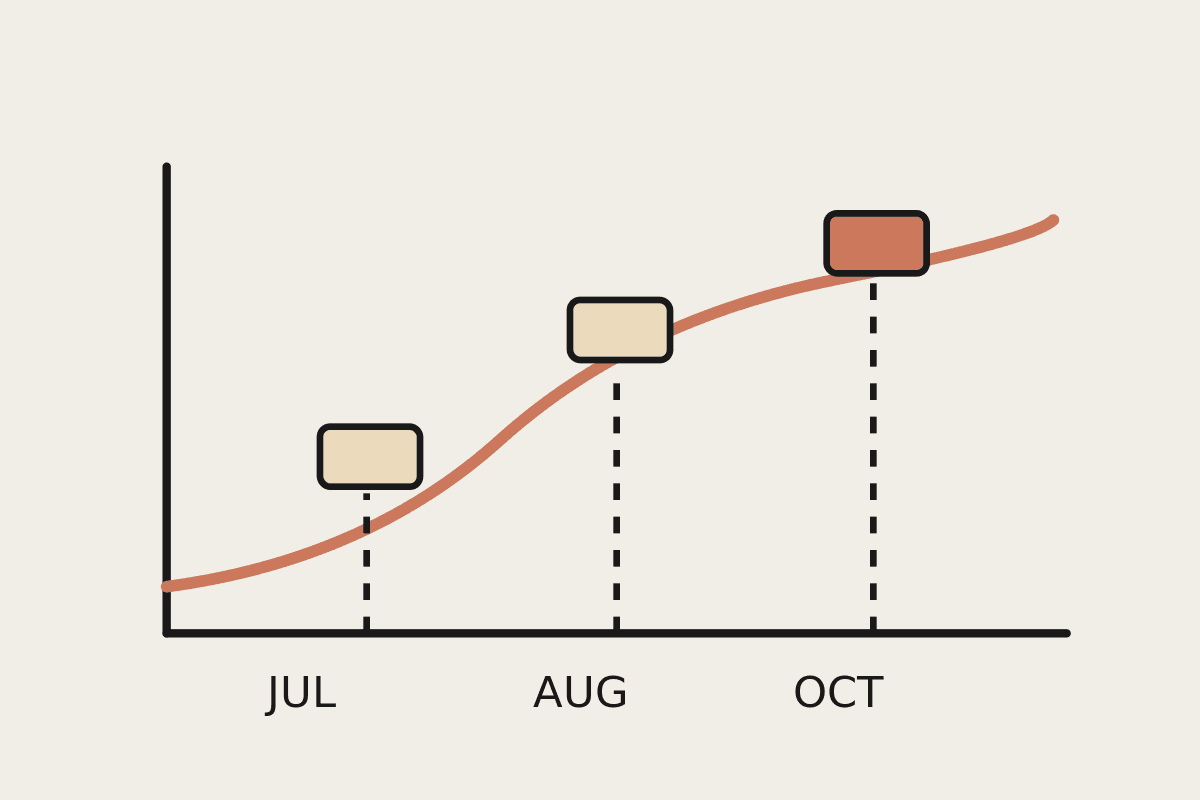
30 June closes the books but opens the season. For Australian accounting firms, July to October is the heaviest stretch of the year: STP finalisations, quarterly BAS, the taxable payments annual report and the first wave of individual returns all land while clients are still sending shoeboxes. The firms that describe this stretch as manageable are not the ones with fewer clients; they are the ones that stopped doing the assembly work by hand.
The deadline stack
14 July: STP finalisation declarations for every employer client
28 July: Q4 BAS and June-quarter superannuation guarantee contributions
28 August: taxable payments annual report for building, cleaning, courier and IT contractor clients
31 October: individual returns for self-lodgers, and the agent lodgement program begins in earnest
Each deadline is manageable alone. The problem is that they overlap, they all draw on the same staff, and every one of them depends on information clients have not sent yet.
Where the hours actually go
Not to advice. Time sheets across firms tell the same story: the season is eaten by assembly work.
Chasing missing bank statements, loan schedules and receipts, then chasing the follow-up
Keying figures from PDFs into ledgers and workpapers
Reconciling payroll and GST before anything can be lodged
Writing the same status-update email to hundreds of clients, one at a time
At a typical charge-out rate of $160 to $220 an hour, every senior hour spent on assembly is either margin lost or overtime paid. Multiply across a fifteen-week season and the number gets uncomfortable quickly, which is why so many firms have historically answered it with offshore preparation teams rather than fixing the workflow itself.
What AI absorbs
Claude Cowork runs on the desktop, reads the client folder, connects to Xero and email, and works through the assembly layer:
Builds an outstanding-document list per client and drafts the chaser emails, which staff review before sending
Extracts figures from bank statements and supplier PDFs into reconciliation-ready spreadsheets
Prepares first-pass BAS and payroll reconciliations with exceptions flagged for a reviewer
Runs a scheduled morning check across the deadline calendar so nothing sits unnoticed
The pattern across all of it is the same: the agent prepares, a person approves. Firms that try to skip the review step are doing it wrong, and firms that skip the automation are paying seniors to do clerical work for a quarter of the year.
The bottleneck underneath every deadline
Strip the season back and one bottleneck sits under all four deadlines: information arrives late, incomplete and in the wrong format. The finalisation cannot be declared until the payroll questions are answered. The BAS cannot be prepared until the missing invoices turn up. The return cannot be drafted until the client remembers the second bank account. Firms have tried portals, checklists and newsletter reminders, and the pile still arrives in September. What changes with an agent in the loop is persistence: the outstanding list is rebuilt every morning from what is actually in the folder, the reminders keep going out in the firm voice, and what arrives gets read, checked against the request and filed the same day. Documents start arriving weeks earlier, and every downstream deadline inherits the slack.
What stays with the accountant
Judgment, advice, declarations and lodgement. The model is review-not-build: staff check AI-prepared workpapers instead of building them from scratch. Nothing goes to a client or the ATO without a human signing off. That boundary is not a limitation to work around; it is what keeps the whole arrangement inside the Tax Agent Services Act and your professional indemnity policy, and it is the reason the time savings survive contact with a compliance review.
The maths a managing partner cares about
A five-partner firm running 15 staff through a fifteen-week season at even five assembly hours per person per week is spending around 1,100 hours on work that produces no advice. Costed at salaries it is real money; costed at a blended $170 charge-out it is more than $180,000 of capacity every season. Recovering even half of it does not require new hires, new software categories or a practice management migration. It requires the assembly layer to stop being manual.
What to do this week
Pick one job type, such as Q4 BAS, and run it side by side: one file prepared the usual way, one prepared by Claude and reviewed by the same senior. Measure the hours honestly, including the review time. Firms that run this test usually find preparation time drops by half or better on the first pass, and further once the skill is tuned to their templates. The season is long enough that a decision made in July compounds through October and into the agent lodgement program beyond it.
A fixed-fee Claude Cowork setup for an accounting firm is $3,500 and is typically live within a week, which still leaves most of the lodgement season to bank the time savings. Book a brainstorm call to scope which jobs to automate first.
This article is part of AI for Accountants in Australia, the complete guide from Automata AI, a Sydney-based Claude consultancy and the automation partner accounting firms across Australia and New Zealand use to put Claude Cowork into production. The approach in every guide is the same: Claude does the preparation, your people keep the judgment.