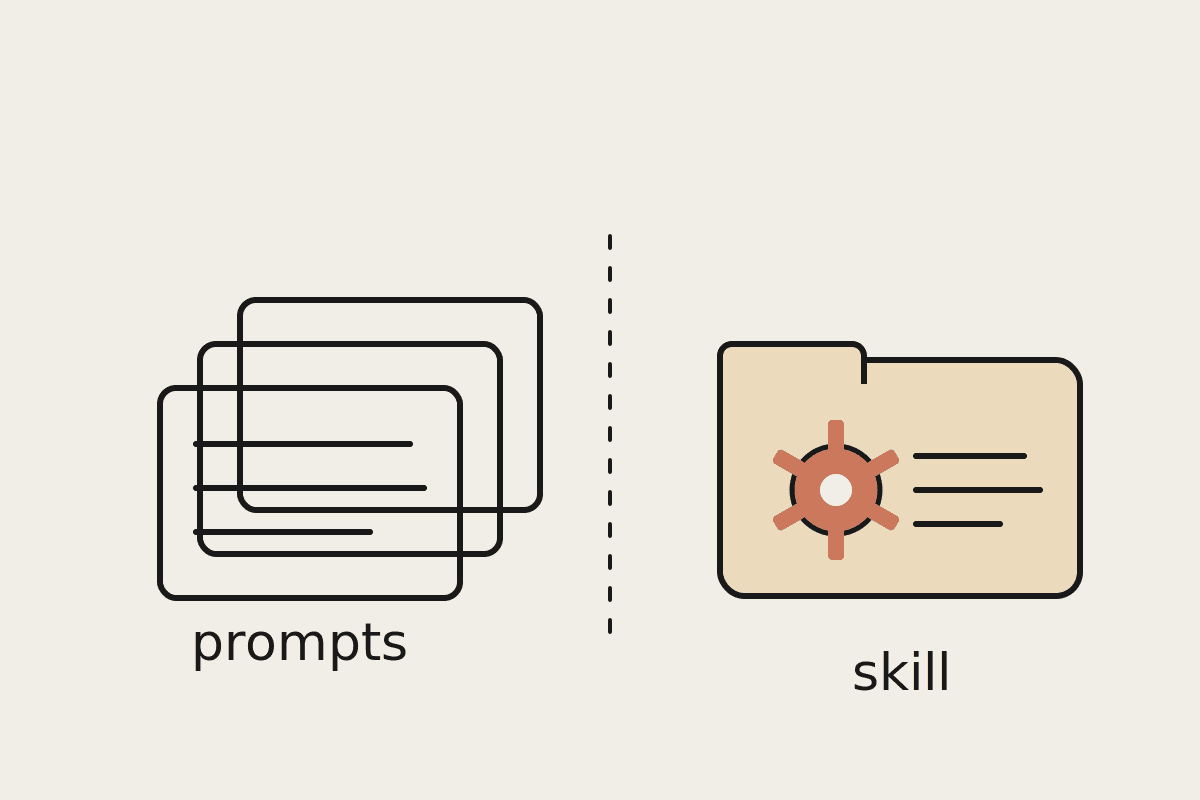
Most teams adopting Claude start the same way. Someone finds a prompt that works, drops it into a shared document, and before long there is a growing file of copy-and-paste instructions. That file is a prompt library, and it is a fine place to begin. The trouble starts when a team treats it as the finish line. A prompt library and a skill library solve different problems, and picking the wrong one quietly wastes hours every week.
What a prompt library actually is
A prompt library is a curated set of text instructions your team reuses. Think of the well-worded request that turns a messy transcript into clean meeting notes, or the paragraph that makes Claude write in your house style. People copy the text, paste it into a chat, adjust a detail, and go.
Prompt libraries earn their keep in three ways. They keep tone and output consistent across a team. They shorten onboarding, because a new starter in your Melbourne office can reach for a proven prompt instead of inventing one. And they capture the small tricks that would otherwise live in one person's head.
The limits appear as you scale. A prompt is static text. It cannot run a script, check a file, or enforce a sequence of steps. It also drifts. Three people copy the same prompt, each tweaks a line, and within a month you have three versions and no reliable way to tell which one is current.
What a skill library actually is
A skill is a packaged capability, not a paragraph. In Claude terms, a skill is a small folder that holds an instruction file, any reference material Claude should read, and optional scripts it can run. Claude loads the skill only when the task calls for it, follows the instructions inside, and can use the attached tools to do real work rather than only describe it.
The difference is the gap between a note to yourself and a trained colleague with a checklist. A prompt reminds Claude what you want. A skill gives Claude the process, the reference data, and the ability to act on it. A skill that drafts a client proposal can pull your pricing table, apply your template, and produce a finished document. A prompt for the same job can only describe those steps and hope the person pasted in the right details.
Reach for a prompt library when:
The task is a one-off phrasing or a tone adjustment.
You want a shared starting point that people will still edit by hand.
The output is plain text, with no file, tool, or fixed sequence involved.
Reach for a skill library when:
The same multi-step job runs again and again across the team.
The task needs reference data, a template, or a script to be correct.
You need one version of the process that everyone runs the same way.
The cost of guessing wrong
Say a 25-person professional services firm in Sydney runs client reporting through a prompt library. Each report takes an analyst about 40 minutes, and half of that is chasing the right template, re-pasting figures, and fixing formatting the prompt cannot enforce. Across the team that is easily 15 hours a week of avoidable handling. At a loaded rate of $75 an hour, the drift costs roughly $58,000 a year, before you count the rework when a stale prompt produces the wrong output in front of a client.
A skill closes most of that gap, because the process, the template, and the data handling live in one place that everyone runs identically. A single well-built reporting skill can pay back its setup inside the first month, then keep returning that time every week after.
Which your team needs
For almost every team, the honest answer is both, in order. Start with a prompt library. It is cheap, it teaches people what good looks like, and it surfaces the workflows that come up over and over. Then watch which prompts get reused the most and graduate those into skills. The prompts everyone reaches for are the exact jobs worth packaging with real logic and guardrails.
The order matters for governance too. If your firm sits under the Privacy Act or APRA oversight, a skill is where you put the rules about what data can be sent, what must be redacted, and which template is approved. A prompt library asks people to remember those rules. A skill enforces them. For a regulated Australian business, that shift from memory to enforcement is often the real reason to move.
Prompt libraries and skill libraries are not rivals. One is where adoption starts and the other is where it pays off. If you are not sure which of your workflows are ready to become skills, that is a short conversation worth having. You can book a brainstorm with us and we will map your most-reused prompts to the two or three skills that would save your team the most time first.