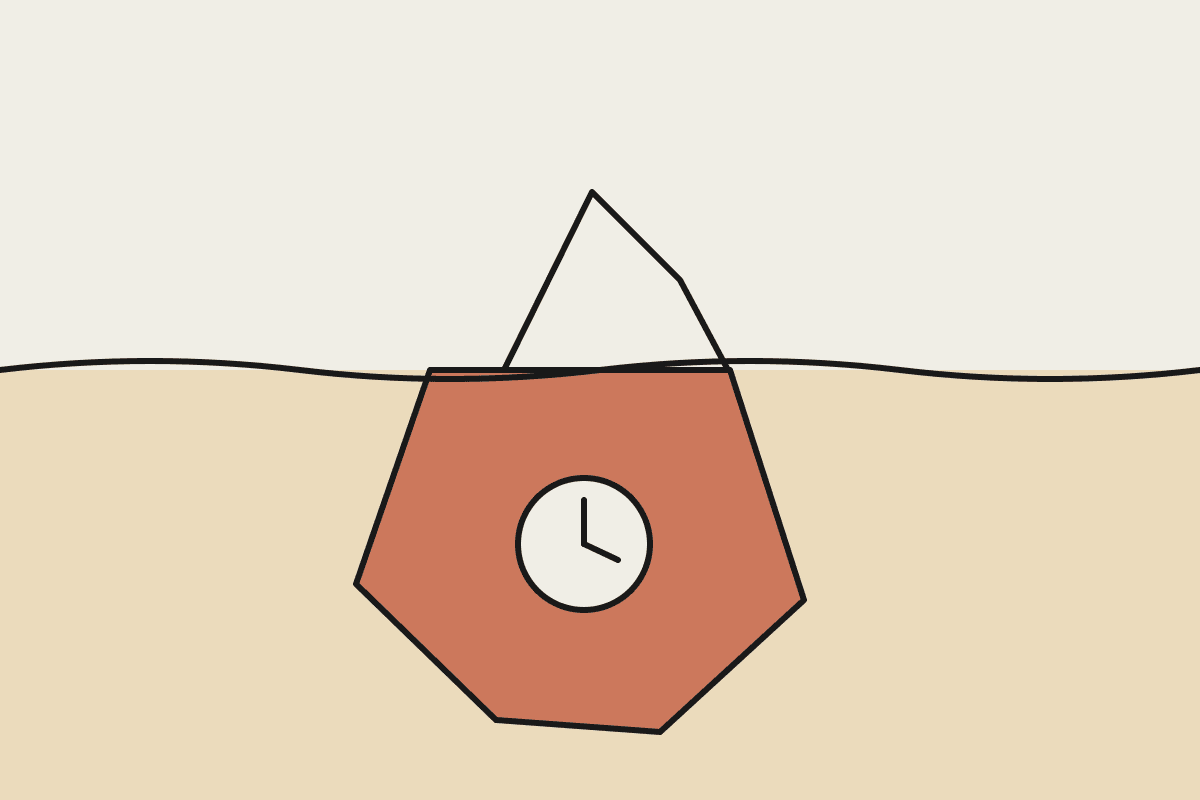
Most Australian businesses that decide to run their own AI rollout start from the price of a subscription. A per-seat licence looks like a rounding error next to the payroll, so the project gets waved through on the assumption that the software is the cost. The software is almost never the cost. The cost is the hours your own people pour into getting that software to do something useful, and those hours rarely make it onto any budget line.
This is not an argument against doing AI work in-house. Plenty of teams should. It is an argument for costing the work honestly before you commit, so the decision to build, buy help, or wait is made with real numbers rather than the sticker on the box.
The sticker price is the smallest number
A Claude subscription for a small team might run to a few hundred dollars a month. Set that against a fully-loaded staff cost of around $120,000 a year for a mid-level knowledge worker in Sydney or Melbourne, and the licence is trivial. The expensive part is everything the licence does not include: the learning, the trial and error, the writing of prompts and instructions, the checking of output, and the slow grind of turning a clever demo into something a team trusts on a Tuesday afternoon.
Here is where the hours actually accumulate on a do-it-yourself rollout:
Learning the tool well enough to use it past the obvious first prompts, which is often 20 to 40 hours per person before real fluency.
Writing and rewriting the prompts, project instructions, and context files that make output reliable rather than plausible.
Wiring the tool into the systems where the work lives, such as your CRM, your document store, or your accounting software.
Checking and correcting output during the months before anyone trusts it unsupervised.
Documenting what works so the knowledge does not walk out the door when one enthusiastic staff member leaves.
Where the hours actually go
The pattern is consistent across the businesses we see in Australia. One or two curious people get excited, spend evenings and weekends experimenting, and produce something that works in a demo. Then the real bill arrives, and it is paid in three currencies that no invoice records.
The learning tax
Getting genuinely good with a tool like Claude is not a one-afternoon exercise. The first prompts are easy. Reliable output on your own messy, real-world documents takes practice. If three people each spend 30 hours reaching fluency, that is 90 hours, and at a blended rate of $90 an hour that single line is worth roughly $8,100 before a single workflow is live.
The integration tax
A chatbot in a browser tab is helpful. A tool that reads your Xero data, drafts against your templates, and files results where your team expects them is a different project. That plumbing is where most do-it-yourself efforts stall, because it needs a mix of technical skill and knowledge of your own systems that few small teams have spare.
The maintenance tax
The rollout is not finished when it works once. Models change, your processes change, and the person who built the original setup moves on. Without documentation and ownership, the whole thing quietly rots, and six months later someone is rebuilding it from scratch.
A worked example
Take a professional services firm of fifteen people that wants Claude to help with proposals, research, and client correspondence. A realistic do-it-yourself first year looks like this. Three staff reach fluency at 30 hours each, so 90 hours. Building and refining workflows across the year adds perhaps 120 hours. Integration attempts, some abandoned, take another 80 hours. Ongoing checking and fixes run to maybe 100 hours.
That is close to 390 hours. At a blended $90 an hour, the internal labour alone is about $35,100. Add the licences and a few false starts on paid tools that did not fit, and the true first-year figure sits comfortably above $45,000. None of that appeared in the original business case, which listed only the subscription.
The point is not that the number is large. The point is that it was invisible. A rollout budgeted at a few thousand dollars actually consumed the equivalent of a quarter of a full-time salary, spread across your best people, during months when they were also meant to be doing their day jobs.
What honest costing changes
Once the hidden hours are on the table, the decision gets easier rather than harder. Some businesses look at the number and decide the learning is worth owning, because AI capability will matter to them for years and building it internally is a sound investment. That is a fine call to make with eyes open.
Others realise their people are worth more on client work than on prompt engineering, and that paying for a guided setup shortens the timeline from months to weeks while capturing the knowledge in documentation rather than in one person's head. The right answer depends on your business. The wrong answer is choosing without counting.
A few habits keep the numbers honest:
Track the real hours your team spends experimenting, not just the licence fees, so the true cost is visible.
Decide who owns the rollout and its documentation before you start, not after the enthusiast burns out.
Set a date to review whether the internal effort is paying back, and be willing to change course if it is not.
We help Australian businesses put real numbers against this decision and, where it makes sense, run the setup so your team keeps doing the work only they can do. If you want a clear-eyed view of what a rollout would actually cost you, book a short call and we will map it out together.