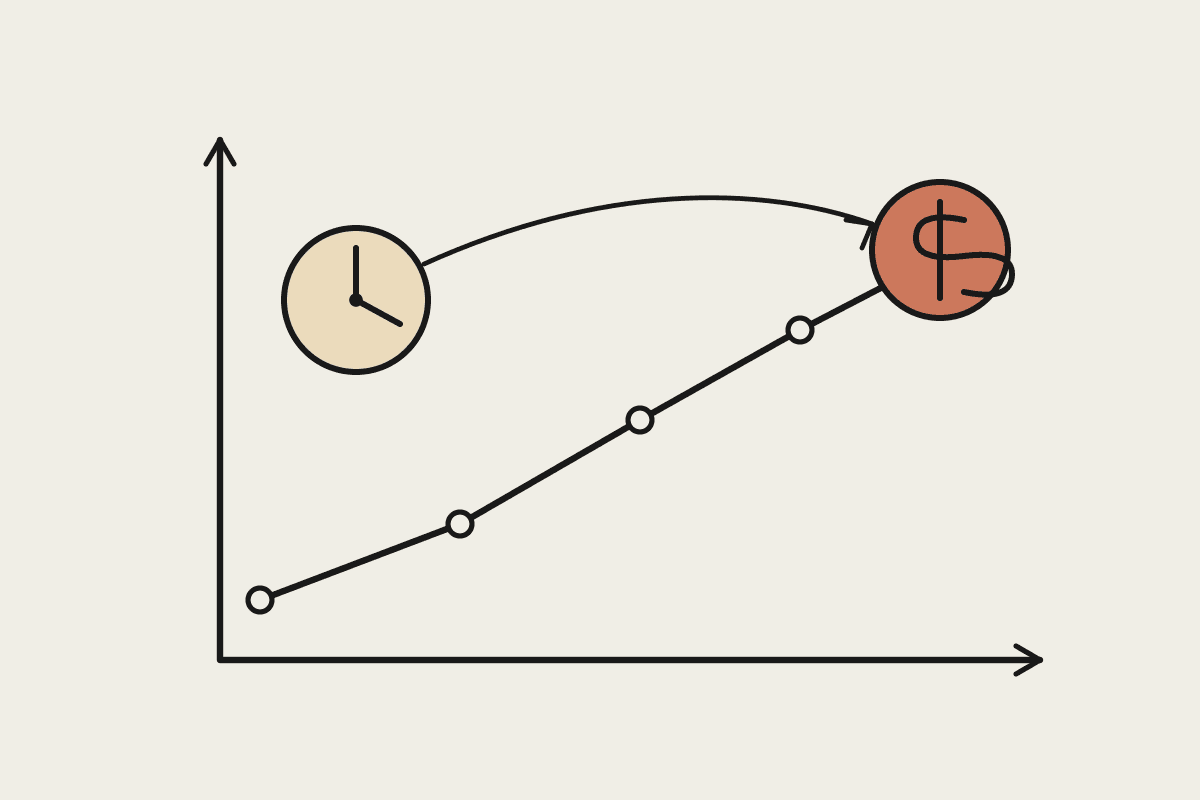
Every AI automation pitch lands on the same number: ten hours a week, handed back to you. It is a useful headline and a poor decision tool. Ten hours saved by a Sydney bookkeeper is worth a fraction of ten hours saved by a partner who bills clients, and none of it counts until you subtract what the automation costs to build and run. This post does the actual maths on a 10-hour weekly saving, three different ways, so you can work out which one describes your business.
Start with an honest hourly rate
The first mistake owners make is valuing saved time at the salary rate on the payslip. That number is too low. The real cost of an hour of staff time includes superannuation, leave, software, desk space and management overhead, so a fair fully loaded figure is usually 25% to 40% above base salary. The second mistake is the opposite: valuing every saved hour at a premium billable rate, as if all of it converts straight into invoiced work. Most of it does not.
Here is a grounded set of Australian rates to anchor the maths:
An admin or bookkeeper on a A$70,000 salary costs roughly A$55 an hour once on-costs and overhead are included.
A qualified accountant or analyst on A$110,000 costs about A$85 an hour fully loaded, and may bill clients at A$180 or more.
A senior consultant or partner bills at A$250 to A$400 an hour, but only a portion of any freed hour returns as new billable work.
Pick the rate that matches the person actually doing the task today. That single choice moves the answer more than anything else in the calculation.
Run the number three ways
Ten hours a week, across a standard 46 working weeks a year, is 460 hours annually. What those 460 hours are worth depends entirely on what you do with them. There are three honest cases.
Case one: cost avoidance
The saved hours belong to admin or bookkeeping work that had to happen but generated no revenue. Value them at the fully loaded rate. At A$55 an hour, 460 hours is A$25,300 a year of staff cost redirected to higher-value work. Nobody is made redundant; the same team simply stops doing the parts a machine handles well, like sorting inboxes, drafting standard replies, reconciling statements and pulling weekly reports.
Case two: billable recovery
The saved hours come off a fee earner who could invoice more if freed up. The ceiling is high: 460 hours at A$180 is A$82,800. The honest number is lower, because holidays, admin and demand gaps mean not every freed hour finds a paying client. If 40% of it re-bills, that is about A$33,000 a year in recovered revenue at close to zero extra cost. This is the case with the best return, and the one most often overstated.
Case three: the hire you avoid
The saved hours are capacity you would otherwise have to buy. A growing Melbourne firm at the point of adding a A$90,000 coordinator can often defer that hire for a year or more by removing the repetitive load first. The value here is the fully loaded cost of the role you did not add, plus the recruitment and ramp-up you skipped.
Now subtract the cost
A saving is not a return until you take out what the automation costs. A realistic small-business Claude build has two parts: a one-off setup and an ongoing run cost. Setting up Claude to work across a firm's files, email and core tools, with the guardrails and procedures written down, typically runs A$8,000 to A$15,000 depending on scope. Ongoing licences and light maintenance sit around A$400 a month, or A$4,800 a year.
Take the cost-avoidance case at A$25,300 of annual value against a A$12,000 setup and A$4,800 of running cost. Year one nets about A$8,500 and pays the setup back in roughly eight months. Year two, with only the run cost left, returns more than four dollars for every one spent. The billable-recovery case pays back faster, and the avoided-hire case usually fastest of all.
Where the maths breaks
Three things quietly wreck these numbers, and an honest case names them up front:
Saved time only has value if it moves to something useful. If the reclaimed hours go to more meetings, the return is zero regardless of the arithmetic.
Adoption takes weeks. Most teams reach the full saving in the second or third month, not the first, so the first-year figure should be discounted for ramp-up.
Not every task should be automated. Work that touches client trust, judgment or regulated advice under the Privacy Act or ASIC rules often stays with a person, by design.
The point of the maths is not a bigger headline. It is a decision you can defend. Work out which of the three cases fits, value the hours at the rate of the person doing the work, subtract the build and run cost honestly, and you will have a number that survives scrutiny from your accountant. If you would like us to run these figures against your own workflows before you commit a dollar, book a short call and we will map it with you.