Anthropic shipped 20 new MCP connectors for legal-industry software and 12 new practice-area plugins in May 2026. For Australian top-tier firms and in-house General Counsel teams, this is the first release where Claude integrates directly with the matter management, e-discovery, and document automation stacks already running inside AU practices. The question is no longer whether Claude belongs in an AU legal workflow. It is which workflows to fold it into first, and in what order. This post walks through the new release, why it lands differently for AU firms than US ones, and how a partner or GC running a 2026 AI budget should sequence adoption across the next two quarters.
What actually shipped
The connector list covers the major US-and-international legal stack: iManage, NetDocuments, Relativity, Litera, HighQ, Practical Law, Lexis+ AI, Westlaw Edge, Clio, Closing Folders, Kira Systems, and several others. Twelve practice-area plugins land on top: corporate transactions, litigation, employment, tax, IP, real property, banking and finance, restructuring, regulatory, competition, privacy, and a general advisory plugin. Each plugin is a packaged set of Claude Skills, retrieval patterns, and example workpapers tuned to the way that practice area actually runs. A litigation associate using Claude with the litigation plugin gets a Claude that knows how a chronology gets built, how a privilege log is structured, and how a brief skeleton typically reads. The generic Claude does not know those things by default.
Why this matters specifically for Australian firms
Three things make the AU read different from the US one. First, AU top-tier firms run on a smaller absolute headcount than their US peers, which means partner time is the binding constraint. Anything that shifts associate-level drafting load off the partner returns directly to billable utilisation. Second, the AU legal market has tighter regulator-led guidance than the US around AI in legal practice. The Legal Services Council's 2025 guidance, the Law Society of NSW's AI principles, and the Australian Solicitors' Conduct Rules together set a clearer floor than what US firms work under. That floor includes supervision obligations, client disclosure expectations, and confidentiality rules that affect what Claude can be wired into. Third, AU corporate GC teams sit at roughly 6 to 14 lawyers across the ASX 200, compared with much larger US in-house teams. A practice-area plugin that gives one in-house lawyer the working depth of a small specialist team is structurally more valuable in a small AU GC office than in a large US one.
Banking and finance teams running CPS 234 advisory work for APRA-regulated clients — the regulatory plugin reads the prudential standards as primary source material rather than inferring from training data.
Employment teams handling Fair Work disputes and modern award interpretation, where the employment plugin knows AU instruments by name rather than treating them as foreign references.
Privacy and cyber teams advising on the Privacy Act 1988 reforms and the OAIC's enforcement posture, where the privacy plugin understands AU notifiable data breach mechanics.
Litigation teams preparing for first-instance hearings in the Federal Court and state Supreme Courts, where the litigation plugin handles chronology building, witness statement drafts, and discovery review at scale.
Corporate M&A teams working on AU public deals subject to FIRB, ASIC, and ASX Listing Rules, where the corporate plugin tracks the actual local procedure rather than US merger mechanics.
The Law Society of NSW's published guidance is the practical reference point. It requires a lawyer using AI to retain personal responsibility for the work product, verify outputs against primary sources, protect client confidentiality, and disclose material AI use where the client expects to know. None of that is a barrier to using Claude with the new connectors. It does shape how a firm should configure them. The connectors must respect existing client matter walls. The plugins must be used as drafting assistance with human review, not autonomous output. And the firm's engagement letter library may need a refresh.
Sequencing adoption for an AU top-tier or GC team
A workable three-phase sequence for an AU firm this year looks like this. Phase one is Claude Chat with the practice-area plugin most relevant to the partner who champions adoption. Eight weeks. Measurable outcome: time-to-first-draft on three named matter types. Phase two is Claude Cowork connected to one matter management system, with two practice plugins active and a small group of associates trained on the workflow. Eight weeks. Measurable outcome: cycle time on the workflows from phase one, plus a documented confidentiality model. Phase three is Platform deployment, a custom in-firm assistant built on Claude, wired to the firm's full document corpus and matter database, with audit logging across every interaction.
A named partner sponsor with decision authority for AI tooling and a budget envelope of at least $80,000 AUD for phase one and two combined.
An IT or knowledge management lead who can sit with each plugin configuration.
A risk and compliance review at the gate between phase two and phase three.
Quarterly executive-committee reporting on usage, time saved, and quality metrics.
What it costs versus what it saves
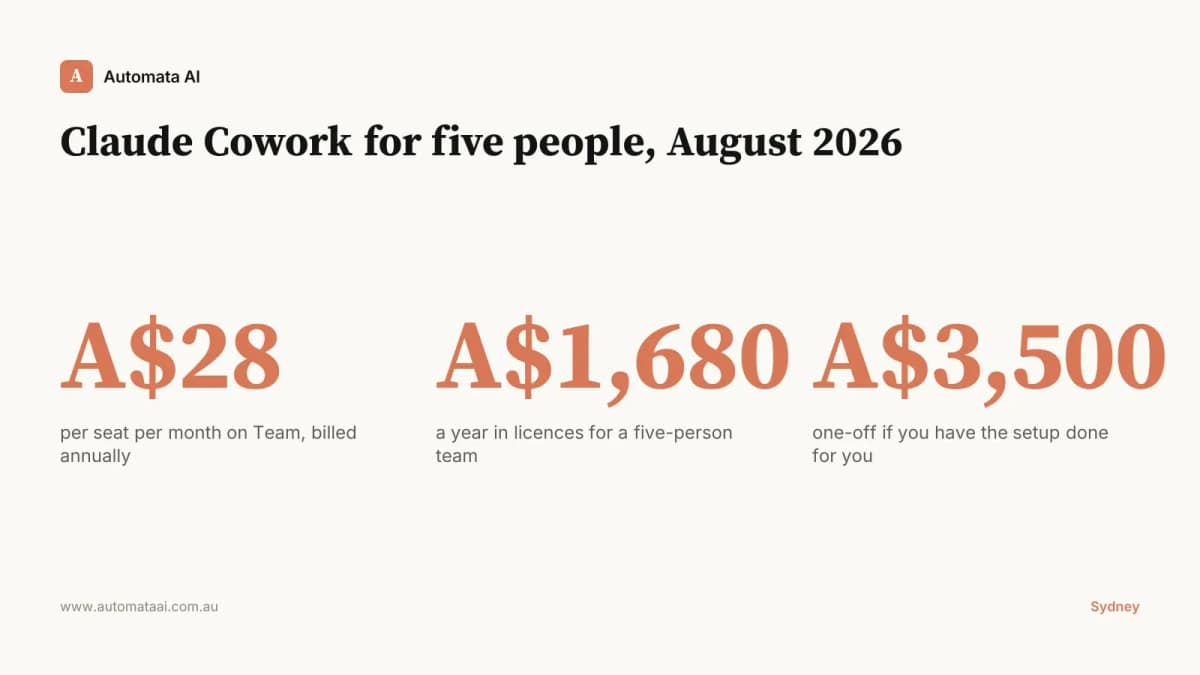
Real AUD numbers for an AU firm with 60 lawyers running this sequence. Phase one costs about $32,000 AUD covering licences, a partner sponsor's time, and external configuration help. Phase two adds about $95,000 AUD for connector setup, matter management integration, and associate training. Phase three is a different scale: a Platform deployment for an AU mid-size firm typically lands between $350,000 and $850,000 AUD depending on the document corpus, the number of practice areas covered, and whether a custom skills layer is built. Against that, the time-savings math for an AU top-tier on workflows like contract review, due diligence triage, and litigation chronology building runs at 30 to 55 per cent reduction in associate hours on the named tasks. For a firm with 60 lawyers, even a conservative 25 per cent reduction on 12,000 associate hours per year at a $620 AUD blended billing rate is roughly $1.86M of annualised capacity returned to higher-value work. Those figures cover the engagement, not the seats. Per-seat licence costs sit on top and are quoted in US dollars by Anthropic; Claude pricing in AUD has the converted figures with the rate and the date they were verified.
What AU GC teams should ask this quarter
For corporate GC teams sitting outside firms, the calculus is slightly different. The connectors plug into systems your panel firms use, not necessarily systems you run in-house. The practice-area plugins still help because most AU GC teams advise across multiple practice areas with very thin headcount. A 10-person ASX 200 GC team covering corporate, litigation, employment, privacy, and regulatory matters benefits from Claude knowing each area natively rather than the GC having to scaffold every prompt with practice context. The right first question for an AU GC team is whether the legal connector release shifts the panel-firm conversation. Specifically, what new metric does your panel firm now offer on matter cycle time, and how does that change the engagement model. The second question is whether your in-house team should run Claude Cowork connected to your matter database directly, without a panel-firm intermediary.
Australian legal practices have run on conservative technology adoption for good reasons. The new release does not change that posture. It does change the cost of waiting. A firm or GC team that has not piloted the practice-area plugins by end of Q3 2026 will be visibly behind peers by Q1 2027, and visibly behind their own clients shortly after. The right move this quarter is a 90-day pilot scoped to one practice area, one named sponsor, and three measurable outcomes. If you want a sounding board on the sequencing, get in touch.