Every Australian business owner asks the same question before signing off on an AI project: when do I get my money back? It is a fair question, and a more useful one than asking how clever the model is. A payback period puts a number on the risk. If a Claude setup costs $3,500 and returns that within three months, the decision looks very different from one that takes two years.
This piece walks through how to work out the payback period on a Claude setup, using figures that match what small and mid-sized firms in Sydney, Melbourne and Brisbane actually see. No hand-waving, just the arithmetic and the assumptions behind it.
What the payback period actually measures
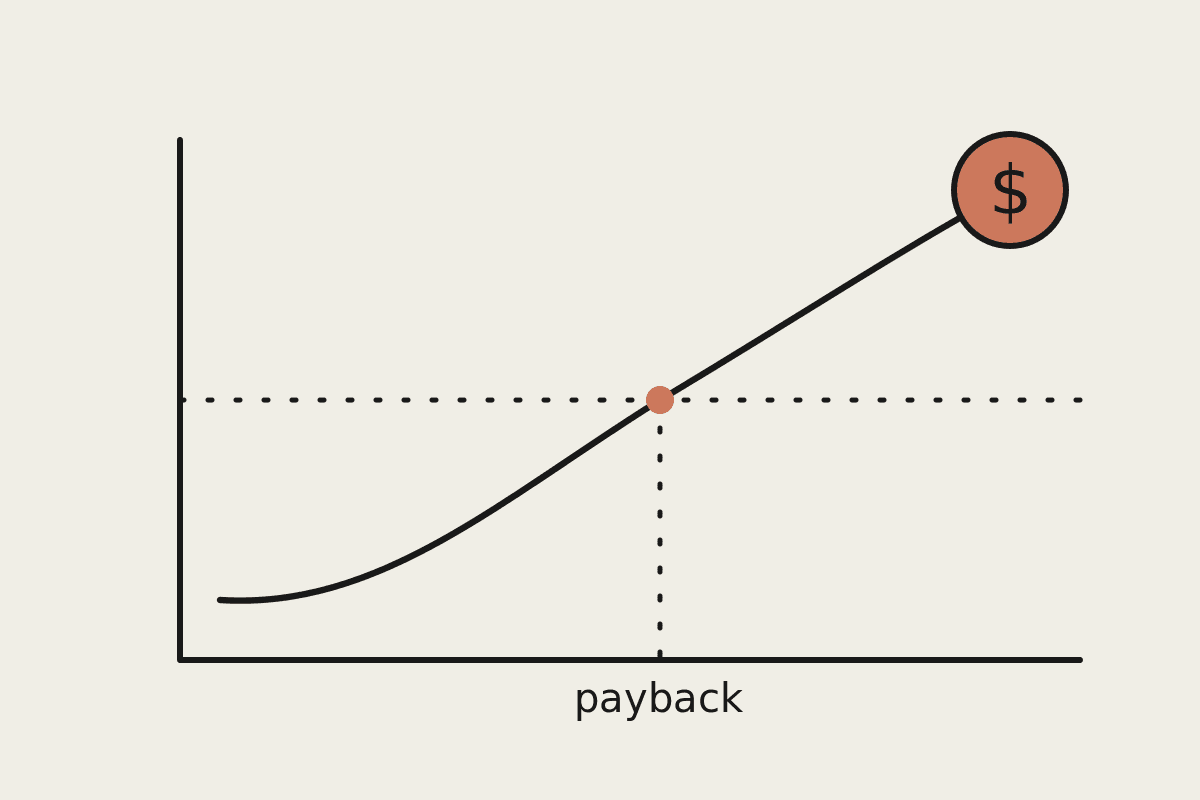
The payback period is the time it takes for the savings from a setup to equal what you paid for it. Work it out with one line: divide the setup cost by the net benefit per month. A $3,500 setup that saves a business $1,400 a month pays for itself in two and a half months. After that point, the savings are yours to keep.
Two things make this calculation honest. First, count the net benefit, not the gross. If Claude saves six hours a week but you spend one hour checking its output, the benefit is five hours, not six. Second, use a fully loaded cost of time, not just a base wage. Superannuation, software and overheads mean an hour of staff time costs more than the hourly rate on the payslip.
A worked example, start to finish
Take a professional services firm with one office manager who spends a large slice of the week on repetitive writing: client emails, meeting notes, first drafts of proposals and monthly reports. Here are the inputs for a realistic Claude setup.
Setup fee: $3,500, one-off, covering configuration, connectors to the tools the team already uses, and a half-day of training.
Time saved: six hours a week, verified over the first month rather than assumed.
Review overhead: one hour a week spent checking and correcting output, subtracted from the saving.
Fully loaded cost of time: $55 an hour, which sits in a sensible range for an Australian administrative or junior professional role once on-costs are included.
Net time saved is five hours a week. At $55 an hour, that is $275 a week, or about $1,190 a month. The payback period is $3,500 divided by $1,190, which lands just under three months. From month four onward, the firm keeps roughly $14,000 a year in recovered time from a single seat.
What moves the payback period up or down
The three-month figure is a midpoint, not a promise. A few factors push it either way, and knowing them helps you set expectations before you spend anything.
Task fit. Work that is high-volume and text-heavy pays back fastest. A team buried in email and document drafting sees returns in weeks; a team with occasional, bespoke tasks waits longer.
Number of people. A setup that helps five staff instead of one does not cost five times as much, so the payback period shrinks sharply as more of the team uses it.
Quality of the setup. A rushed configuration produces output that needs heavy correction, and every extra review hour eats into the benefit. Good guardrails at the start protect the return.
Compliance handling. If your work touches personal information, the setup has to respect the Privacy Act from day one. Getting that right up front avoids rework that would otherwise stretch the payback period.
How to measure it honestly
The most common mistake is measuring the benefit you hoped for rather than the one you got. Pick two or three tasks, time them for a fortnight before the setup, and time them again after. The difference is your real saving. It is less flattering than a vendor estimate, and far more useful when you are deciding whether to expand.
It also pays to separate one-off setup cost from ongoing cost. A Claude subscription and any usage fees are small next to staff time, but they belong in the sum. A setup that saves $1,190 a month against $80 of ongoing cost still clears its fee quickly, and the monthly maths stays firmly positive.
What we tell business owners before they commit
A short payback period is a good sign, but it is not the whole story. The setups that keep paying off are the ones tied to work the business does every week, with a person who owns the output and checks it. When those conditions hold, a payback period of two to four months is a reasonable expectation for an Australian small business, and the recovered time compounds well beyond the first year.
If you want to sanity-check the numbers for your own team, we are happy to work through them with you. You can book a short brainstorm and we will map the likely payback period against your actual tasks before you spend a cent.