Most teams brief Claude on a new landing page with something like ‘make it clean and modern’, then spend the rest of the afternoon nudging the result back toward their brand. The fix is not a longer prompt. It is a file Claude reads every time it builds: a DESIGN.md. Here is how Australian businesses use one to get on-brand output from Claude Code and Claude Cowork without re-explaining themselves on every task.
Two files, two jobs
Many teams already keep an AGENTS.md or CLAUDE.md that tells Claude how a project should be built: the stack, the conventions, the commands to run. A DESIGN.md answers a different question. What should the thing look and feel like? Between them, Claude gets both the engineering rules and the design rules before it writes a single line of code.
A good DESIGN.md can describe:
The colour system, spacing scale, and typography limits
Component behaviour and interaction states
Motion principles, and when motion is actually worth using
Content and microcopy style, down to how an error message should read
The value is specificity. ‘Clean and modern’ means nothing to an agent, because it means something different to every person who reads it. A rule like ‘every error message must tell the user what to do next’ or ‘cap body text at two font weights’ gives Claude something concrete and repeatable to apply. You are no longer hoping it guesses your taste. You are handing it the decisions, in a form it can act on without a follow-up conversation.
Why this beats a longer prompt
A prompt is spent the moment the task ends. Type it, get your output, and the context is gone. A DESIGN.md persists across every run. Vercel publishes its own DESIGN.md as a public example, and it goes well past colours and fonts. It covers hierarchy, spacing, when colour is allowed, when motion helps, and how copy should read. That is the level of detail an agent can execute against without a designer sitting next to it for every screen.
For an Australian small business, the first payoff is time. A Sydney studio that spends two hours re-briefing brand on every prototype is burning real money. At a blended rate of $150 an hour, ten prototypes a month works out to $3,000 of rework that a single well-written file removes. Write the rules once, and every build after that starts on-brand instead of drifting and getting corrected.
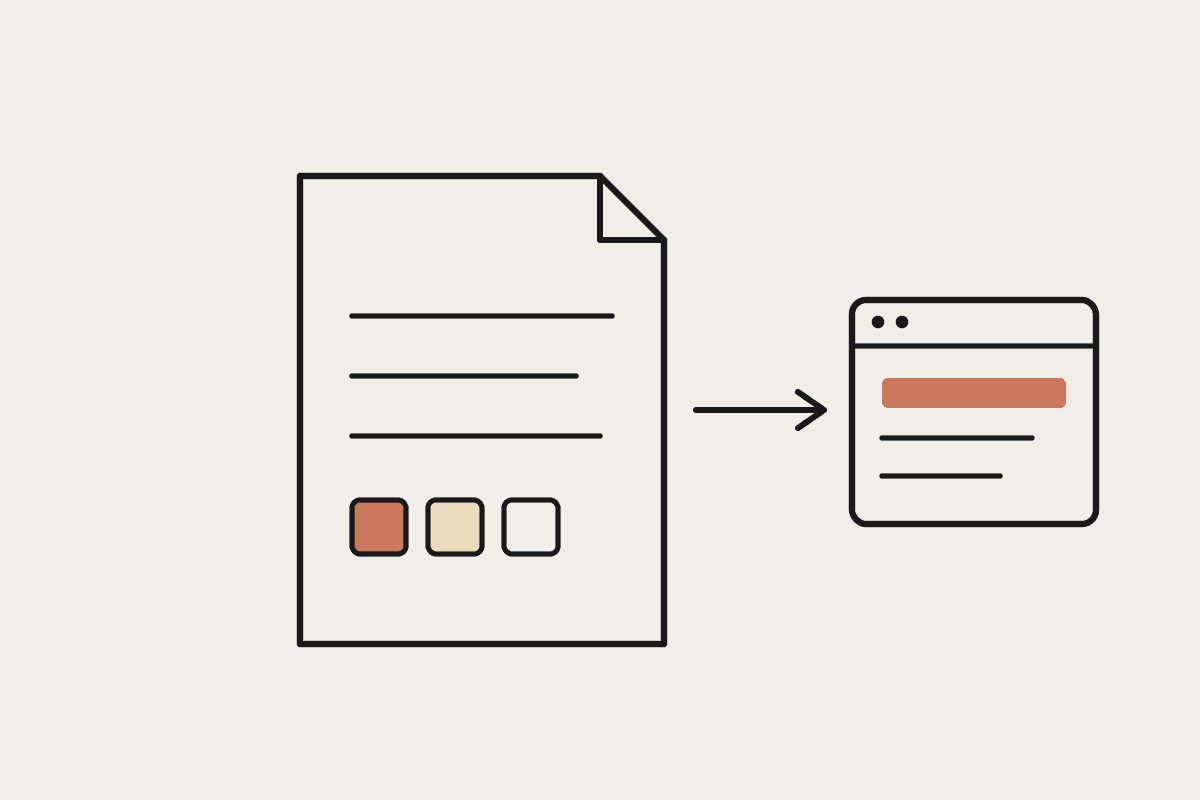
The second payoff matters more over time. A traditional style guide was written for people to read and interpret. A DESIGN.md turns those same decisions into something an agent can read, reuse, and apply directly. Your design system stops being a PDF nobody opens and becomes a live input to the work. The gap between what the brand says and what actually ships gets smaller, because the same file drives both.
How to write one that works
You do not need to copy anyone else's file. The useful move is to study how a few products translate a feeling into rules, then write your own version. Notion reads as structured and editorial. Airbnb reads as warm and lifestyle-led. Linear reads as sharp and technical. You might borrow the structure of one, the warmth of another, and the interaction discipline of a third, then encode those choices as your own tokens and rules.
A practical starting shape:
Start with the non-negotiables: brand colours, the two or three fonts, and the spacing scale
Add the ‘when’ rules: when to use an accent colour, when motion earns its place, what an empty state should show
Write the copy rules: voice, casing, and how errors and confirmations should sound
Keep it short enough that Claude reads the whole file on every run without crowding out the real task
Drop the file at the root of the project so Claude Code or Cowork picks it up, then reference it from your CLAUDE.md so it loads on every task. Treat it as a living document. When Claude ships something off-brand, the fix is usually not another nag in the chat. It is one more line in the DESIGN.md, so the next build and every build after it gets it right.
For MVPs, landing pages, dashboards, and quick prototypes, this is far more flexible than starting from a fixed template each time. The agent still does the building. The file makes sure it builds the thing you would have designed yourself, on the first pass rather than the third.
Automata AI helps Australian businesses set up Claude Code and Claude Cowork with the guardrails and design rules that keep output on-brand. Book a brainstorm.