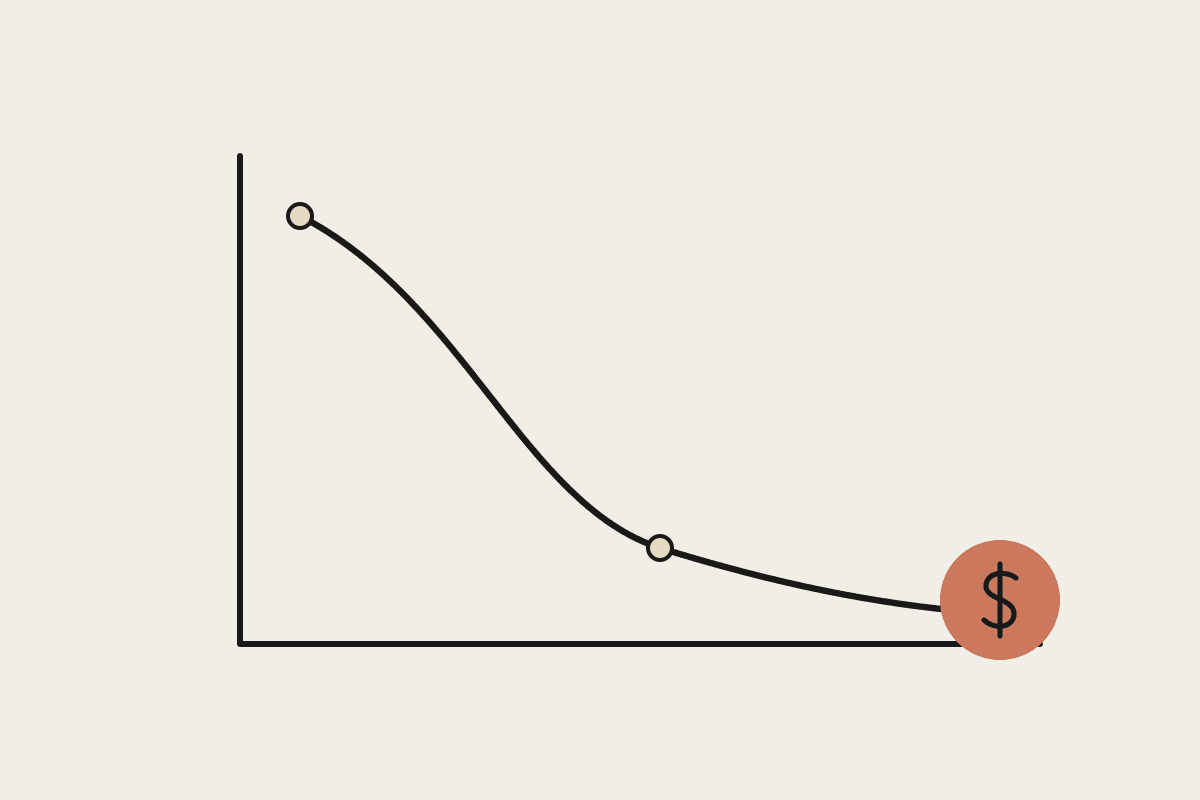
Industry analyses put the price of AI inference on a steep slide. The cost of a fixed level of capability has been falling by roughly ten times a year, driven by open-weight competition, better hardware utilisation and price wars among providers. DeepSeek's V4 Flash now lists at about US$0.14 per million input tokens, a figure that would have looked like a typo in 2024. Claude's own pricing has moved the same way for equivalent capability.
Here is the pattern we keep seeing in Australian businesses. Someone senior reads about falling prices and concludes the smart move is to wait: wait for cheaper tokens, wait for the next model, start the AI project next financial year. The logic feels prudent. It quietly costs a fortune.
The instinct to wait is understandable. Nobody wants to sign up for a price that halves six months later. But that framing treats AI spending like a one-off capital purchase, when for most businesses it behaves more like a utility bill that keeps getting cheaper while the value it produces stays flat or rises. You do not delay switching on the lights because electricity might be cheaper next year.
Why waiting loses money
The savings from automation are a stream, not a lump sum. Miss six months of the stream and it never comes back.
A workflow saving $4,000 a month in staff time, forgone for six months, is $24,000 gone permanently.
Cheaper tokens later do not refund the manual work you paid for in the meantime.
Competitors who started earlier bank both the savings and the process learning, and the second one compounds.
Token prices are also a shrinking share of total cost. In most small business deployments we scope in Sydney and beyond, model usage runs $200 to $800 a month, while the real value sits in redesigned processes, connectors and staff adoption. A 90 per cent cut in a $500 line item is welcome. It is not a reason to delay a $4,000 monthly saving.
Budget for deflation instead of hiding behind it
Falling prices are a planning input, not a stop sign. A few practical ways to build deflation into your AI budget:
Assume your per-unit inference cost halves every 12 months, but build the business case on today's prices so deflation becomes upside rather than a dependency.
Keep commitments short: monthly plans and pay-as-you-go APIs, not multi-year token contracts.
Design workflows to be model-portable, so you can take price improvements from whichever provider ships them, whether that is Claude or an open-weight challenger.
Revisit unit economics twice a year and expand the workload set as marginal costs fall.
The one case where waiting is rational
There is a single exception: heavy up-front GPU purchases. Spending $60,000 on hardware to self-host an open-weight model locks in current price-performance while the curve is still falling fast. Renting, whether Claude by the API call or GPUs by the hour, keeps you on the right side of deflation and lets you re-price your stack every few months without stranded capital.
What to do in the next 90 days
If you want to act rather than wait, pick one process with a clear monthly cost and a repeatable shape: quoting, invoice matching, first-line support, or report drafting. Scope it on today's Claude pricing, ship a small pilot, and measure the hours returned. Australian teams that run this loop once almost always find the token bill is a rounding error against the labour saved.
Choose a workflow where you can name the monthly dollar cost today.
Run a two-week pilot on current pricing, not a six-month planning cycle.
Track hours saved and error rates, then decide whether to widen the scope.
A worked example, in round numbers
Take a services firm in Melbourne running quotes by hand. Two staff spend roughly 20 hours a week between them preparing and formatting proposals. Put Claude behind that workflow with your own templates and CRM, and the drafting collapses to a review-and-approve step. Say it returns 12 hours a week at a loaded rate of $55 an hour: that is about $2,860 a month, or north of $34,000 a year. The Claude usage to run it might be $300 a month. Waiting a year for that usage to fall to $150 saves $1,800 while forgoing $34,000 in labour. The maths is not close.
Keep the compliance side honest too
Cost is not the only planning input. If your workflow touches personal information, Privacy Act obligations apply from day one, not from the day tokens get cheap. Building the process now means you design consent, data retention and human review into it while the scope is small, rather than retrofitting controls onto a system that has already spread across the business. Australian teams that treat governance as part of the pilot avoid the expensive rework that comes from bolting it on after the fact.
Deflation is real, and it is good news. It is just not a reason to leave money on the table this quarter. If you want a business case built on current prices with falling costs treated as honest upside, book a free brainstorm with us.