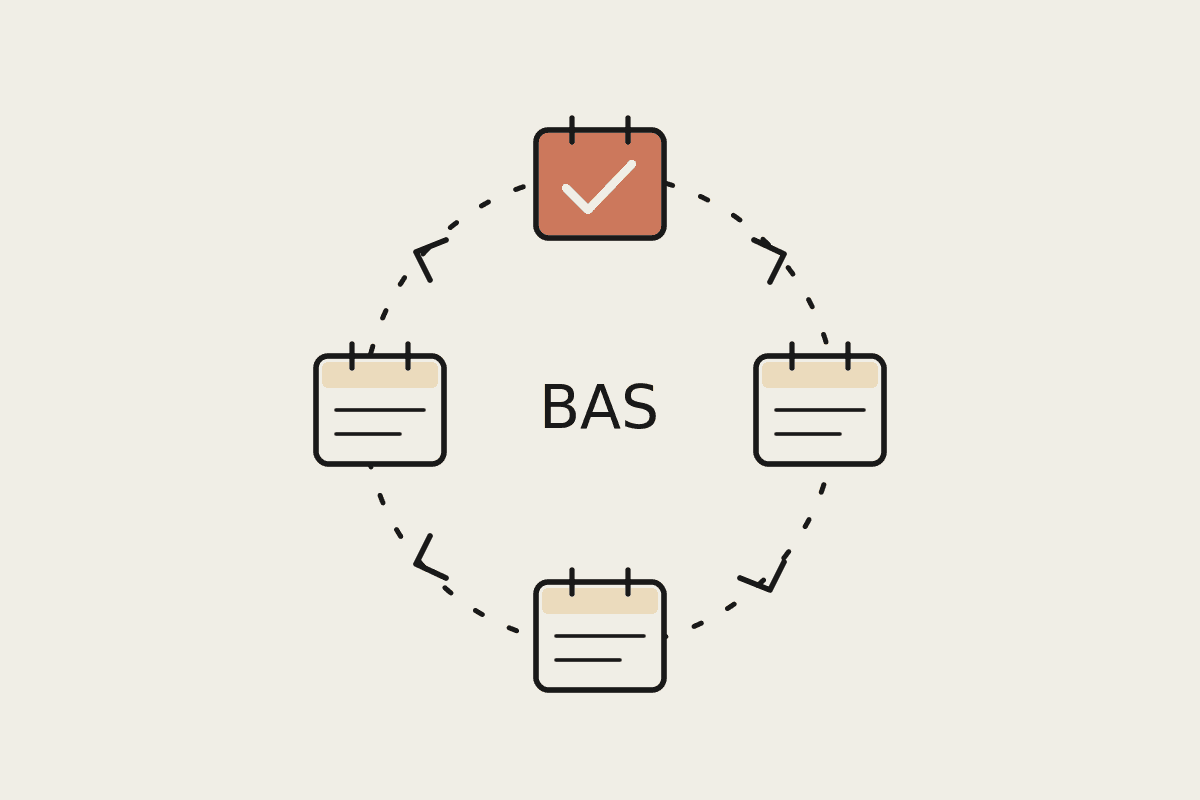
Every Australian business registered for GST lives on a four-beat clock. The Business Activity Statement falls due four times a year, and each one arrives whether the books are ready or not. For a small business owner or a bookkeeper running several clients, the quarter has a habit of sneaking up: the deadline is known months out, yet the scramble still happens in the final week. The answer is not working harder in that last week. It is building a repeatable rhythm across the whole quarter, and letting Claude carry the parts that are purely mechanical.
Why the quarter catches good businesses out
The GST registration threshold in Australia is $75,000 in annual turnover, which means most growing businesses cross into quarterly BAS territory right when they are busiest. The statement itself is not hard to complete. What makes it stressful is the reconciliation debt that builds up quietly: uncoded transactions, a stack of receipts photographed but never filed, a supplier invoice that never made it into the accounting file. None of that is visible until you sit down to lodge, and by then the deadline is days away.
The cost of getting it wrong is not abstract either. The ATO applies a failure-to-lodge penalty that starts at one penalty unit (currently $330) for a small entity and climbs for each 28-day period the statement is late. General interest charges accrue on unpaid amounts on top of that. A business that misses two quarters in a row can find itself several hundred dollars down before it has paid a cent of actual GST. The rhythm below is designed to make late lodgment a non-event rather than a recurring risk.
Four dates, one repeatable routine
If you lodge your own quarterly BAS, the standard ATO due dates are the anchor points of the whole year. Registered tax and BAS agents often get a later concession under the lodgment program, but the quarters themselves do not move. Put these four in the calendar once and the shape of the year becomes obvious:
Quarter 1 (July to September): BAS due 28 October.
Quarter 2 (October to December): BAS due 28 February, reflecting the summer holiday period.
Quarter 3 (January to March): BAS due 28 April.
Quarter 4 (April to June): BAS due 28 July, straight after the end of the financial year.
The trick is to treat each of these not as a single day of work but as the end of a repeating 13-week loop. The same handful of tasks happen in the same order every quarter, which is exactly the kind of predictable pattern an assistant is well suited to support.
Where Claude fits, week by week
Through the quarter
The biggest saving comes from not letting work pile up. Rather than reconciling three months of activity in one sitting, keep it moving in small weekly passes. Claude can read an exported transaction list and draft a first-pass GST coding, flag the entries it is unsure about, and produce a short plain-English note of anything that looks out of place, such as a private expense sitting in a business account or a supplier charging GST when they are not registered for it.
Draft GST codes for new transactions and separate the confident calls from the ones needing a human eye.
Summarise the week's uncoded or unusual items into a two-minute review list.
Keep a running note of questions to ask the accountant before quarter end, so nothing is left to the last day.
The week before lodgment
If the weekly rhythm has held, the final week is a review rather than a rescue. This is where Claude helps you check the story the numbers tell. Ask it to compare this quarter's GST collected and GST paid against the previous three quarters and explain any large swing. A sudden drop in GST on sales might be genuine seasonality for a Sydney retailer heading into a quiet month, or it might be a sign that a whole revenue stream was miscoded. Catching that before you lodge is far cheaper than amending afterwards.
Reconcile the BAS figures against the accounting file and list any variance worth explaining.
Produce a one-page summary a business owner can approve in a few minutes.
Draft the payment or refund note so the cash position is clear before the due date.
After you lodge
The quarter is not finished when the statement is submitted. Take ten minutes to capture what went wrong and feed it back into the next loop. Claude can turn your rough notes into a short checklist of process fixes: a supplier whose invoices always arrive late, a category that keeps getting miscoded, a receipt source that needs a better filing habit. Over a year, that reflection is what turns a stressful quarter into a quiet one.
What to automate and what to keep human
A compliance calendar is only worth building if it is trustworthy, so be deliberate about the split. Claude is a strong drafting and review partner, not the final authority on your tax position. The lodgment itself, the sign-off on GST treatment, and any judgement call about a grey-area transaction should stay with a person, ideally your registered BAS or tax agent. Under the Privacy Act, you also want to be careful about the financial data you share and where it goes; keep client and business records inside tools you control, and avoid pasting identifiable detail into anything you have not vetted.
Good to hand over: first-pass coding, variance summaries, checklist drafting, plain-English explanations of the numbers.
Keep with a human: final GST treatment, the actual lodgment, and any decision the ATO could question.
Build your own BAS calendar this week
You do not need new software to start. A shared calendar and a repeatable prompt or two are enough to change the shape of your quarter. A simple setup a bookkeeper might spend a few hundred dollars of time building once, against the $4,000 or more a year some businesses lose to rushed rework and late penalties, pays for itself inside a single cycle:
Put all four due dates in the calendar now, each with a reminder two weeks out.
Block a recurring 30-minute weekly slot for the reconciliation pass.
Save a standard set of prompts for coding, variance checks, and the pre-lodgment summary so you are not rewriting them each quarter.
Add a short post-lodgment review to the day after each due date.
The businesses that stay calm at BAS time are rarely the ones with the fanciest systems. They are the ones that turned a four-times-a-year panic into a quiet weekly habit. If you would like help designing that rhythm around Claude for your own business or your client base, book a short brainstorm with us and we will map it out together.