"Which Claude model do I actually need?" is one of the most common questions we hear from Australian business owners looking at automation. It sounds like a simple question, but the honest answer used to be "it depends," followed by a long explanation of trade-offs. On 24 July 2026, Anthropic published a proper model-picking guide that settles a lot of that ambiguity. The advice is more nuanced than picking whatever is cheapest, and it changes how we recommend Claude builds for clients in Sydney, Melbourne and further afield. This post breaks down what the guide actually says, what the current model family looks like, and what it means for your budget.
Anthropic's Default Advice: Start Smart, Not Cheap
Anthropic's default recommendation is to start with the most intelligent generally available model for the task, then use effort level controls to dial cost and speed up or down as needed. That is a reversal of the instinct most business owners have, which is to reach for the cheapest model that seems to work and only upgrade when something breaks. Anthropic's own guidance argues the opposite approach usually wins. Rather than starting cheap and upgrading only when a workflow fails, you start with the strongest available model, confirm it clears your bar, and then step down deliberately once you understand the economics of the task.
For business owners this is a mindset shift. It treats model choice less like a fixed budget line and more like a dial you adjust once you have evidence, not before.
The Claude Model Family, In Plain Terms
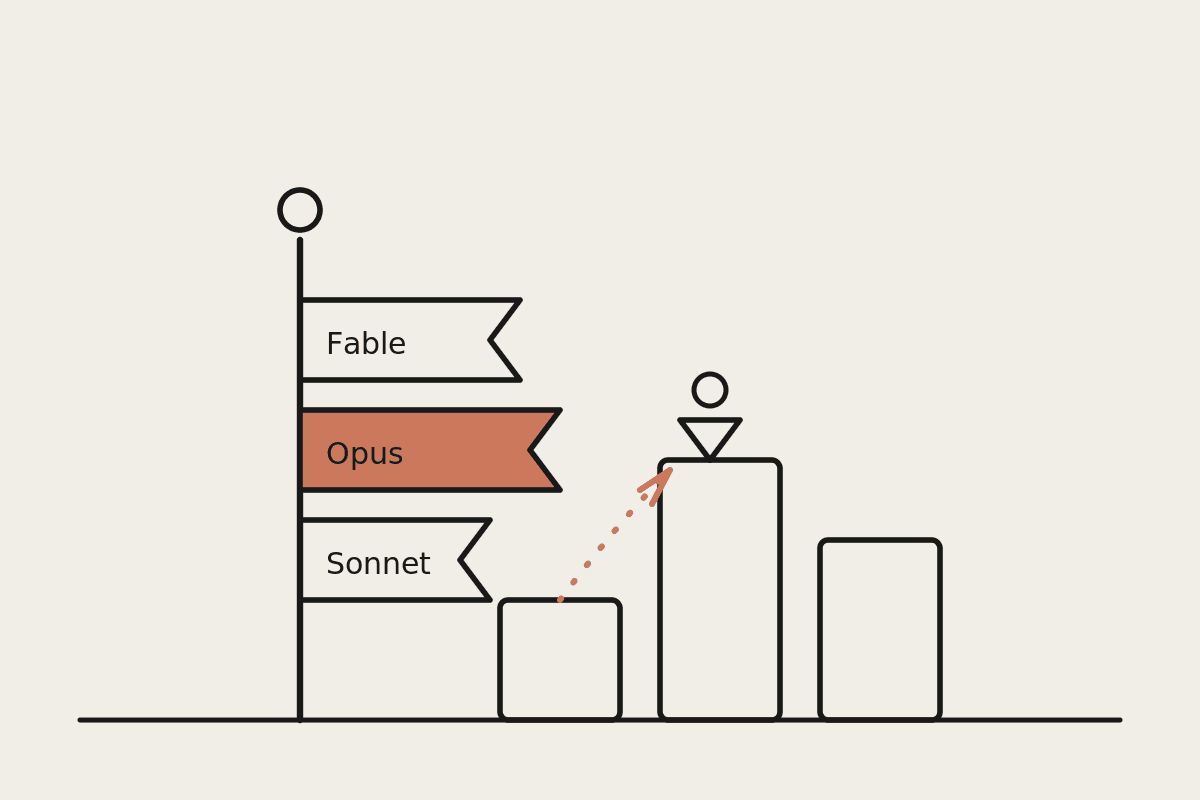
The current Claude line-up breaks into three practical tiers. Here is how Anthropic frames each one, and where we typically see each one land in AU client work:
Mythos and Fable: Anthropic's most capable tier. Mythos is built for organisations doing dual-use cybersecurity and biology work under stricter controls, while Fable is the public-facing version with extra safeguards attached. Both are aimed at long-running agent tasks and problems that have not been reliably solved by AI before.
Opus: the enterprise reasoning workhorse. It is competitive with Fable on many benchmarks but priced lower. Anthropic's own advice is direct: if Opus is failing your evaluations, move up to Fable. If Opus is clearing the bar, its speed and price make it the better default for ongoing use.
Sonnet: the versatile mid-tier model. This is what most Claude Cowork sessions and day-to-day business automation runs on, and it is the workhorse behind a lot of the client builds we ship.
None of these tiers is inherently "the AU business tier." The right one depends on what the task actually demands, not on what feels safest to budget for on day one.
Why "Start Smart" Beats "Start Cheap"
Anthropic's reasoning here is counterintuitive on the surface, but it matches what we see across client engagements. Cost-per-task is often lower with a more capable model, even though the price-per-token is higher, because a stronger model needs fewer retries and less back-and-forth to land the right answer. Starting with a smaller model also makes it harder to diagnose what went wrong when a result is bad. Is it a model limitation, or is it a setup problem in your prompt, your data, or your workflow design? Either way, working that out burns hours you did not budget for.
Here is the number that tends to change minds in a discovery call. For a Sydney business spending roughly $1,500 to $3,000 AUD a month on a Claude-powered workflow, a single extra retry loop per task, multiplied across thousands of monthly runs, can quietly cost more than simply starting with the stronger model in the first place. The cheaper model was never actually cheaper. It just moved the cost from the invoice to your team's time.
Our Take for AU Teams
Based on Anthropic's guidance and what we have seen running Claude workflows for Australian clients, here is how we would apply this in practice:
Do not default to the cheapest model "to be safe." Test the top-tier model first on a realistic sample of your actual workload, then step down only if the economics genuinely demand it.
Use effort-level controls to fine-tune cost inside a single model, rather than jumping down a whole model class to chase minor savings.
Re-evaluate your model choice every time Anthropic ships a new tier. What was the right call on Opus 4.8 is not necessarily the right call on Opus 5, and workflows locked in six months ago are worth revisiting.
What This Means If You Are Already Running Claude Cowork
If your business already has a Claude Cowork setup running day-to-day automation, this guide is directly relevant, because Sonnet is the model most Cowork sessions run on by default. That is generally the right call. Sonnet is built as the versatile mid-tier model for exactly this kind of ongoing business automation, and for most repeatable workflows, such as drafting client correspondence, summarising meeting notes, or triaging inbound leads, it is a sensible default rather than a compromise.
Where this guide matters is at the edges. If a particular workflow inside your Cowork setup keeps needing manual fixes, keeps producing answers you do not trust without checking, or handles a task that genuinely requires deeper reasoning, that is a signal worth testing against Opus rather than accepting as "just how Cowork works." The fix is not always a bigger prompt or a longer instruction file. Sometimes the fix is a different model tier for that one workflow, while everything else stays on Sonnet.
This is also where the effort-level controls Anthropic points to become useful in practice. You are not locked into an all-or-nothing choice between a cheap model and an expensive one across your entire operation. You can run most of your business on the mid-tier model and reserve the top-tier model, dialled to the effort level a task actually needs, for the handful of workflows where getting it right the first time matters more than shaving cents off the token bill.
Questions Worth Asking Before You Lock In a Model
If you are scoping a new Claude workflow, or auditing one that is already running, these are the questions we walk through with clients before recommending a model tier:
What does the task actually require: fast pattern matching, or genuine multi-step reasoning over ambiguous inputs?
How many retries or manual corrections is your current setup absorbing, and who is absorbing that time?
Is your monthly Claude spend closer to $1,500 or closer to $3,000 AUD, and does that number reflect the model tier, the retry rate, or both?
Would effort-level tuning inside your current model solve the cost problem, or is the model itself the wrong tier for the job?
When did you last revisit this decision against the newest available model?
Most Australian businesses we talk to have never formally answered these questions. They picked a model once, usually the cheapest available option, and have not revisited it since. Given how quickly Anthropic ships new tiers, that is worth a second look, particularly if your workflow touches anything sensitive enough to sit near Privacy Act obligations or client data handling expectations.
If you are not sure which Claude model or plan actually fits your workload, that is exactly the kind of audit we run for AU businesses before recommending a build. Book a brainstorm session with Automata AI and we will walk through your current setup, your spend, and whether you are on the right model tier for what you are actually trying to do.