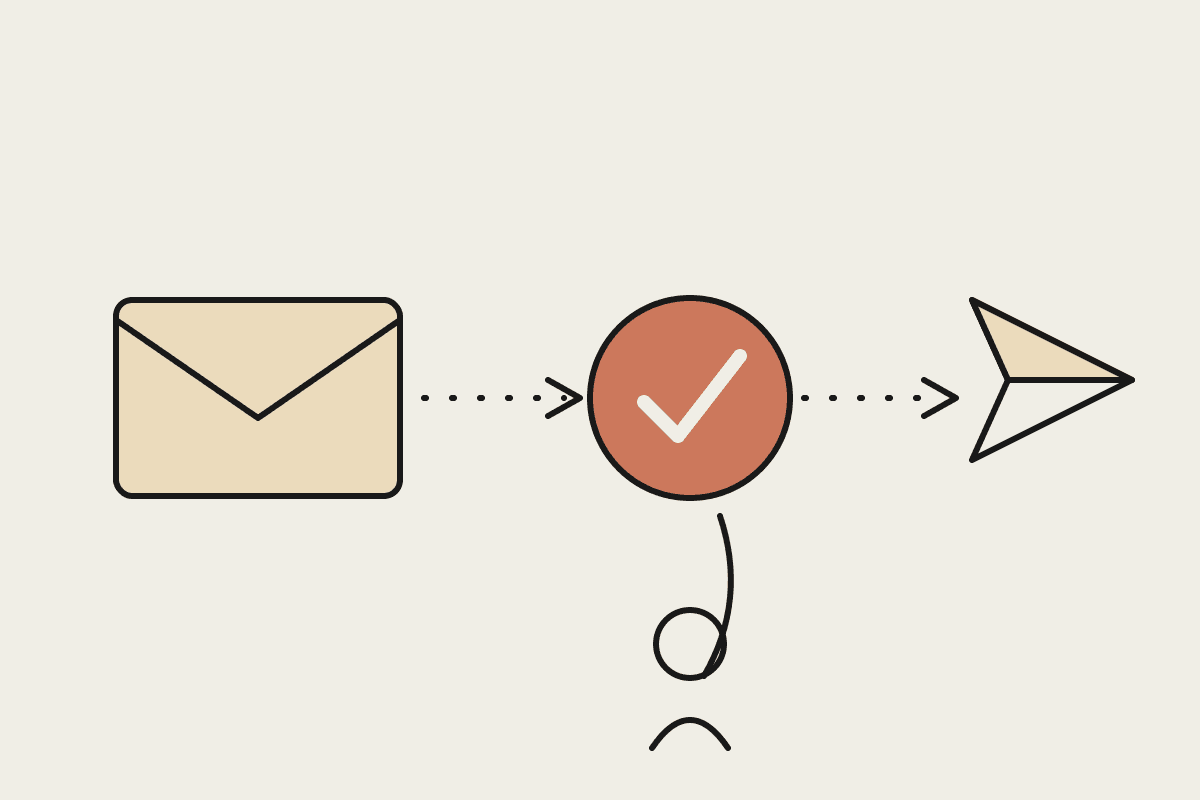
The single most reliable control for any AI email workflow is the one Automata AI runs on its own client work: draft, never send. Every email Claude prepares sits as a draft for a human to read and approve before it leaves the building, and that one rule prevents the overwhelming majority of the genuinely bad outcomes owners worry about when they first consider automating email.
Why draft-never-send beats more elaborate safeguards
Businesses often reach for complex permission systems, approval workflows, content filters, staged rollouts, before trying the simplest control available: nothing sends without a person clicking send. That single gate catches tone problems, factual errors, and anything genuinely inappropriate before a customer or prospect ever sees it, and it costs nothing to implement beyond a habit change. More elaborate controls have their place once volume is high enough that a human reading every draft becomes the bottleneck, but that's a later-stage problem, not a starting one.
Draft-never-send: the single highest-value control, implement this before anything else
Scoped recipient lists: restrict which addresses an automated draft can even be prepared for
Tone and content review by a second person for anything client-facing until trust is established
A clear escalation path for anything the drafting step itself should have flagged but didn't
What genuinely needs review versus what can move faster
Not every email needs the same scrutiny. An internal reminder draft between colleagues carries low risk if it's slightly off. A first outreach email to a prospect, a response to a complaint, or anything with a commercial commitment in it carries real risk and deserves a proper read, not a skim. Tiering review effort to the actual stakes, rather than applying uniform scrutiny to everything, is what makes draft-review sustainable at any real volume rather than becoming its own bottleneck.
A Sydney agency's actual workflow
A Sydney marketing agency uses Claude to draft weekly client update emails from campaign data, every draft lands in a review queue an account manager clears each morning, typically in under ten minutes for five to six drafts. In four months of running this, one draft was caught with an incorrect metric before it reached a client, an error that would have taken an awkward correction email to fix and cost real credibility with that account. The ten minutes a day of review time is a fraction of what drafting those updates manually used to take, while keeping the single point of human judgement that catches the rare genuine mistake.
What to do as trust builds
What the review habit is actually worth
Put a number on it and the case for keeping the gate becomes obvious: a single wrong email to an important client, an incorrect figure, a tone-deaf response to a complaint, can cost far more than the cumulative review time saved by skipping the check. The Sydney agency example above estimated the one caught error would have cost roughly $2,000 in remedial work and account-management time to smooth over, against a review habit costing under an hour a week total. That's not a close call, and it's the calculation worth doing before deciding a review step is too slow to keep.
For businesses in regulated sectors specifically, financial services under APRA oversight, or anywhere handling sensitive personal information under the Privacy Act, the draft-review gate does double duty: it's both a quality control and, in many cases, a documented step that demonstrates human oversight of an automated process, which regulators and auditors increasingly expect to see evidenced rather than simply claimed. Keeping a simple record of what got reviewed and by whom costs almost nothing to maintain and becomes valuable exactly when someone asks how the business ensures AI-drafted communications get proper oversight.
None of this is meant to sound more complicated than it is. The core habit is genuinely simple: nothing leaves without a human clicking send, reviewed proportionate to the stakes involved. Everything else, tiering, logging, loosening the gate over time, is refinement built on top of that one non-negotiable starting rule, not a replacement for it.
As a workflow proves itself over weeks and months, it's reasonable to loosen review for the lowest-stakes categories, purely internal notifications, for example, while keeping the gate firmly in place for anything client-facing or carrying a commitment. The mistake to avoid is loosening the gate because reviewing feels tedious rather than because the evidence actually supports it. Keep a simple log of what review has caught, and let that log, not impatience, decide when it's genuinely safe to automate a step further.