The question we get asked is what Claude Cowork costs. The question people mean is whether it will pay for itself, and those have very different answers.
The licence is the cheap part. It is almost never what decides the outcome.
How much does Claude Cowork cost in Australia?
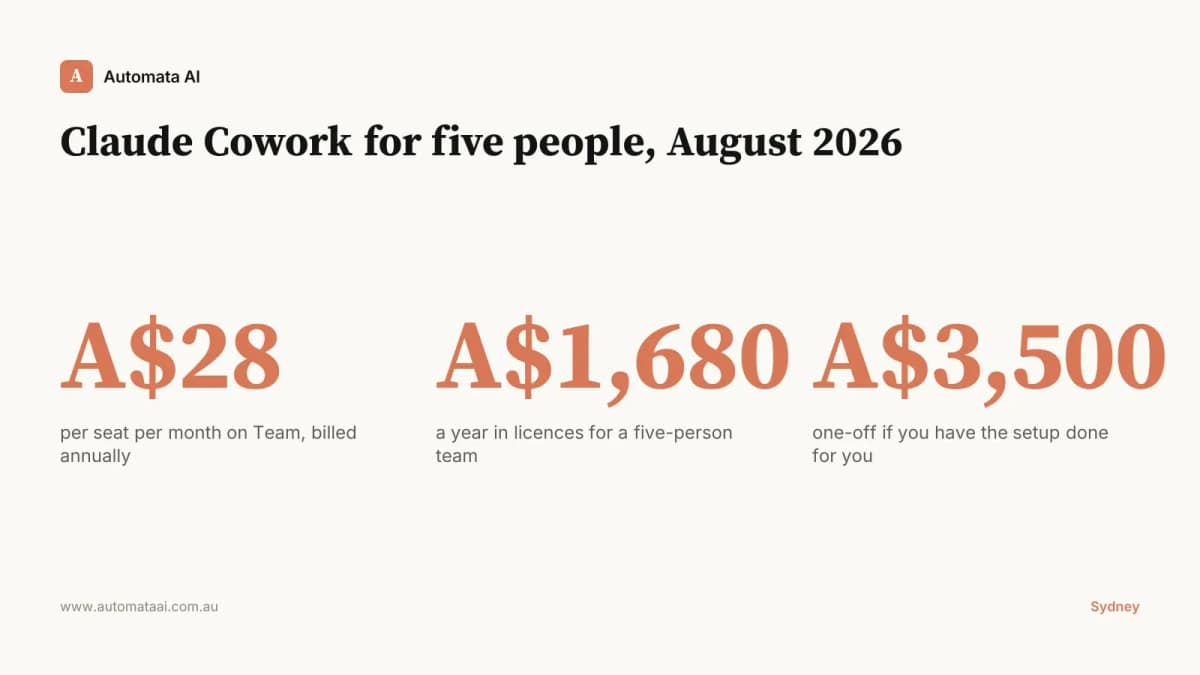
Claude Cowork is not sold separately. It is included with paid Claude plans, so the licence cost is the plan cost: about A$28 a month for Pro, and from about A$28 per seat per month on Team billed annually, converted at the rate on 25 August 2026. A five-person team on Team seats is roughly A$1,680 a year. Anthropic bills in US dollars, so those figures move with the exchange rate, and most Australian cards add an international transaction fee of around 3 per cent on top. Setup is the other cost, and it is usually the larger one.
What is included in the Claude plan price?
Every paid tier includes Cowork. What changes between them is how much you can run before you hit a limit, and whether you get shared billing and admin controls.
Pro. One person doing real work. The right place to find out whether the job you had in mind actually suits an agent, before anyone signs a team up.
Max. From about A$140 a month. Worth it for the one or two people running long Cowork sessions all day, not for a team because the team is busy.
Team. Shared projects, one invoice, central seat management. Minimum seat counts apply, and premium seats cover the people who would otherwise need Max.
Enterprise. SSO, domain capture and audit logging. The trigger is a security review or an audit obligation rather than a headcount number.
Every plan, every tier and the exchange rate behind each figure sits on our Claude pricing in Australia page, which is the one we keep current. Anything quoted in a blog post, including this one, is a snapshot of the day it was written.
What does Claude Cowork actually cost a five-person team?
Three routes, all real. One costs money and saves a week, one costs a week and saves money, and one costs nothing and tells you which of the other two you actually want. The figures below assume five people on Team seats billed annually.
| Line item | Year one | Each year after |
|---|---|---|
| Claude Team seats, five, billed annually | $1,680 | $1,680 |
| Self-setup using a free guide | $0, plus roughly a week of evenings | $0 |
| Free Cowork call, we look at your setup | $0 | $0 |
| Fixed-fee setup, done for you | $3,500 one-off | $0 |
| Total, self-setup route | $1,680 | $1,680 |
| Total, done-for-you route | $5,180 | $1,680 |
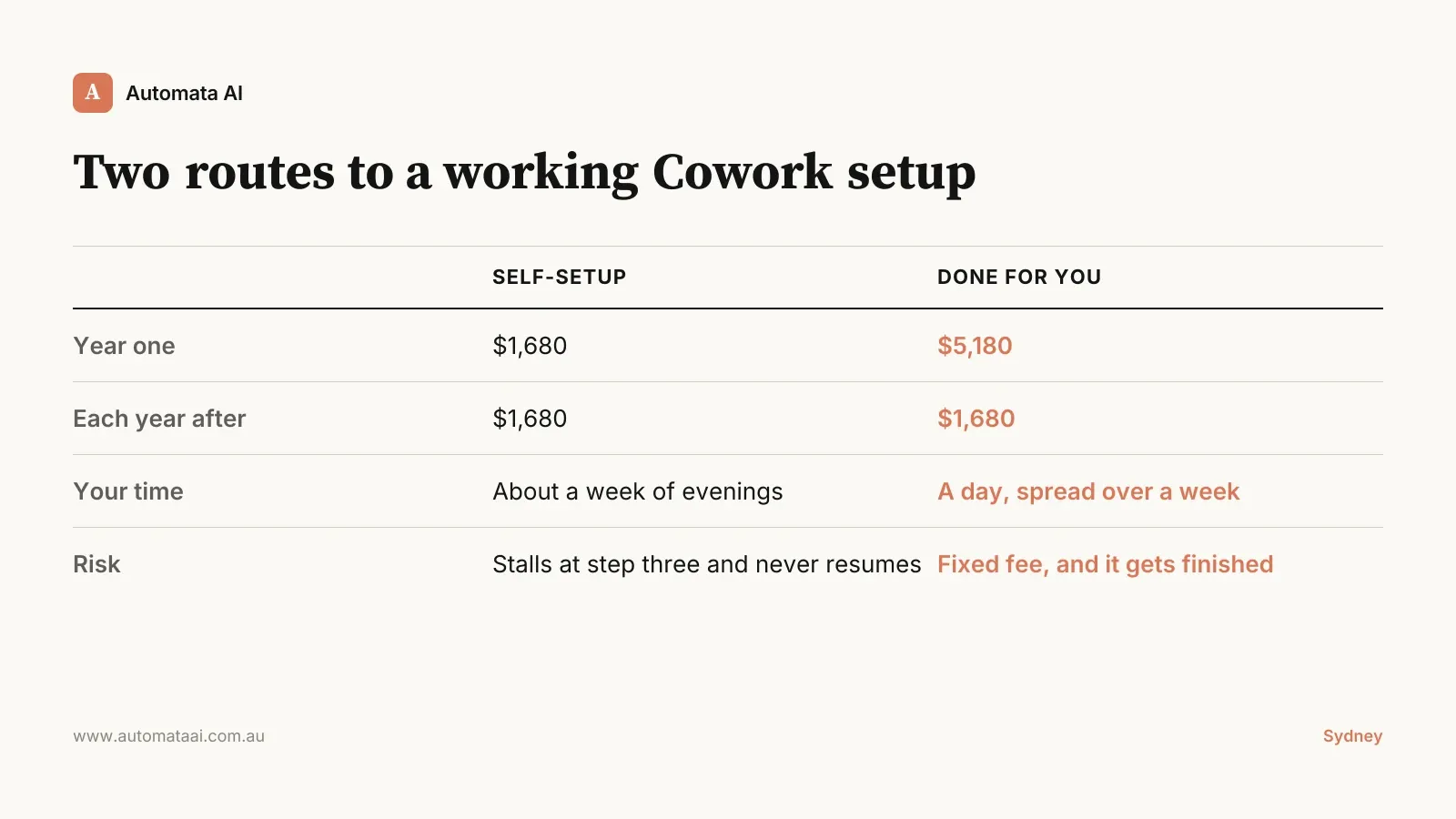
The gap between the two paid-for-or-not totals is $3,500 in year one and nothing after that. Whether it is worth paying comes down to what a week of the owner’s evenings is worth, and whether the self-setup actually gets finished. The failure mode we see most often is not a bad setup. It is a setup that stalled at step three in March and was never picked up again. If you cannot tell which route you are, that is what the free call is for.
If you want to try it yourself first, the Claude Cowork setup guide walks the seven steps with free templates, and we will still say that is the right call for plenty of businesses. If you get part-way and stall, book the free Cowork call from that page — we will look at what you have built, sort out what is not working, and tell you honestly whether the rest is worth doing yourself.
What are the hidden costs of Claude Cowork?
Three costs never appear on a pricing page, and together they matter more than the licence.
Usage, not licences. Agent runs that read a lot of files consume far more of a plan allowance than chat does. A heavy Cowork user reaches their limit sooner than the same person on the chat app, and the fix is a higher tier for that one person rather than for everyone.
Review time. Everything customer-facing needs a person between the draft and the send button. That review is real work. Budget it, because an automation whose output nobody has time to check is an automation nobody uses.
The machine staying awake. Cowork runs in the desktop app, so scheduled tasks stop if the app closes or the laptop sleeps. For a business that wants a Monday morning brief waiting, that is a real constraint and occasionally a hardware decision.
When is Claude Cowork not worth the money?
At A$1,680 a year the licence bar is low enough that almost anything clears it, which is exactly why the question deserves an honest answer. Cowork is the wrong purchase in three cases.
The work is genuinely different every time. Cowork earns its money on repetition. A business whose weekly output has no shape gets a clever assistant and no compounding return.
Nobody will own it. Somebody has to work the exceptions and adjust the workflows as the business changes. Where that person does not exist, the system runs for six weeks and is then quietly ignored.
Your data cannot leave Australia. There is no Australian data residency for Cowork today. API-level residency exists through AWS Bedrock, Google Vertex and Microsoft Foundry, but that is a different build. If you hold obligations under the Privacy Act or a client contract that fixes where data sits, settle that before buying seats, not after.
There is a fourth case worth naming even though it is not a cost problem. If the team has not agreed what the process is, Cowork will automate the disagreement. Write the process down first. That step is free and it shortens everything after it.
The number that actually decides it
Pick the single task you would hand over first. Count how many hours a month it takes and multiply by a fully loaded rate, which for most Australian mid-market admin work lands between $85 and $120 an hour. If that figure clears A$5,180 in the first year, the done-for-you route pays for itself inside twelve months and the licence was never the question.
If you are not sure which task to pick, the free AI readiness assessment takes seven questions and returns a shortlist. Start there, then come back to this table with a real number in hand.