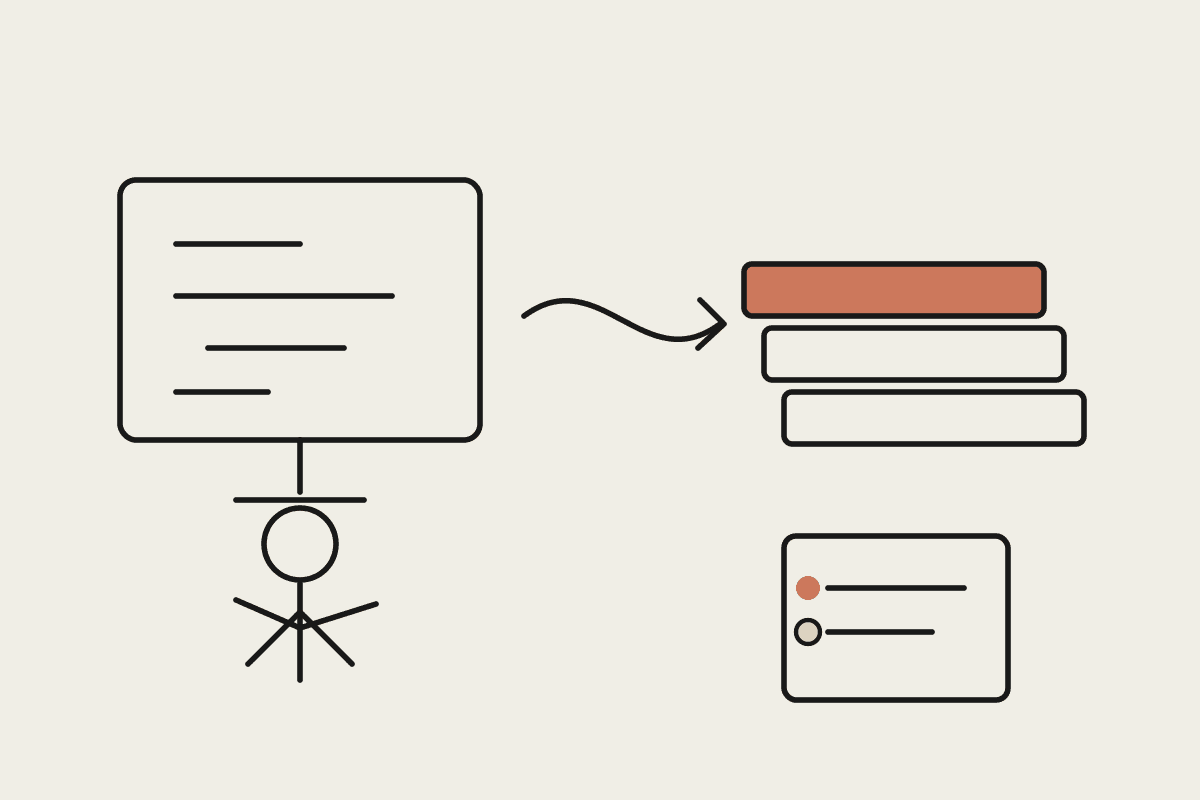
Every engineering team has house rules that aren't strictly correctness issues but matter for consistency: a preferred error-handling pattern, a house style for comments, a convention for how test files are named and structured. New hires learn these by osmosis over a few months of code review feedback, picking up the unwritten rules one corrected PR at a time. Claude Code doesn't have that osmosis, and by default it writes in a generically reasonable style that may not match what your team's actually converged on.
Why default output style rarely matches a mature codebase
Claude Code's defaults are sensible and broadly idiomatic, but 'broadly idiomatic' and 'matches this specific team's conventions' are different things. A team that's standardised on Result types instead of exceptions for error handling, or that has a strict rule against default exports, or that writes tests in a particular given-when-then structure, will find the agent's unguided output technically correct but stylistically off, which means every PR needs a review pass just to catch style drift, on top of reviewing the actual logic, and that extra pass is exactly the kind of low-value, high-friction work senior engineers resent spending their time on, especially when it recurs on nearly every PR the agent touches.
House error-handling patterns documented so the agent applies them by default, not just when reminded
Test structure and naming conventions specified once, applied consistently across every generated test
Comment style and documentation conventions matched to what the team actually maintains, not generic boilerplate
Import ordering, file structure, and naming conventions specified so generated code passes lint on the first attempt
Building an output style that actually sticks
The practical approach is a CLAUDE.md or output-style configuration that captures your team's conventions as explicit, example-backed rules rather than vague prose. 'Use our error-handling pattern' is a weak instruction; showing an actual example of the pattern with a short explanation of when to use it is a strong one. Teams that write output style configs as a genuine style guide, complete with a couple of real code examples, get dramatically more consistent output than teams that write a one-line reminder and hope for the best, largely because the agent, like a new hire, learns far better from a concrete example than from an abstract instruction.
A Brisbane fintech engineering team had been getting Claude Code output that passed tests and logic review but consistently needed a second pass for style: wrong error-handling pattern, test files that didn't match their given-when-then convention, inconsistent import ordering. After building a proper output-style configuration with worked examples for each convention, style-related review comments dropped by roughly 70% across the following month, and the team's lead engineer estimated that was saving close to four hours a week of review time that had been going into style nitpicks rather than substantive logic review.
Keeping the config from going stale
A style guide that isn't maintained drifts out of sync with how the team actually codes within a few months, especially on a codebase that's evolving quickly. The teams that keep this working treat updates to the output-style config as part of normal PR review: if a reviewer flags a style issue that isn't already covered, that's a signal the config needs updating, not just a one-off correction to that PR.
What this is worth in practice
Putting a number on review time saved is easier than it sounds once a team's tracking it: at a typical senior engineer's fully loaded cost, four hours a week of avoided style-nitpick review across a six-person team works out to somewhere in the vicinity of $35,000 a year in recovered engineering capacity, before counting the harder-to-measure benefit of reviewers actually focusing their attention on logic and architecture instead of formatting, which is where a senior engineer's review time is genuinely worth spending.
What this isn't
Output style configuration won't fix inconsistent conventions that already exist across an older codebase; it standardises what gets written going forward, not what's already there. For a codebase with genuinely inconsistent existing patterns, this is a good moment to also decide, as a team, which pattern is actually the house standard rather than assuming Claude Code should guess, since an agent asked to infer a convention from inconsistent examples will just average across them, and an average of two conflicting styles is a third, worse style nobody actually wanted.
Automata AI helps Australian engineering teams build output-style configurations that actually reduce review overhead rather than adding another document nobody reads. Get in touch via /contact if style drift is costing your team review time.