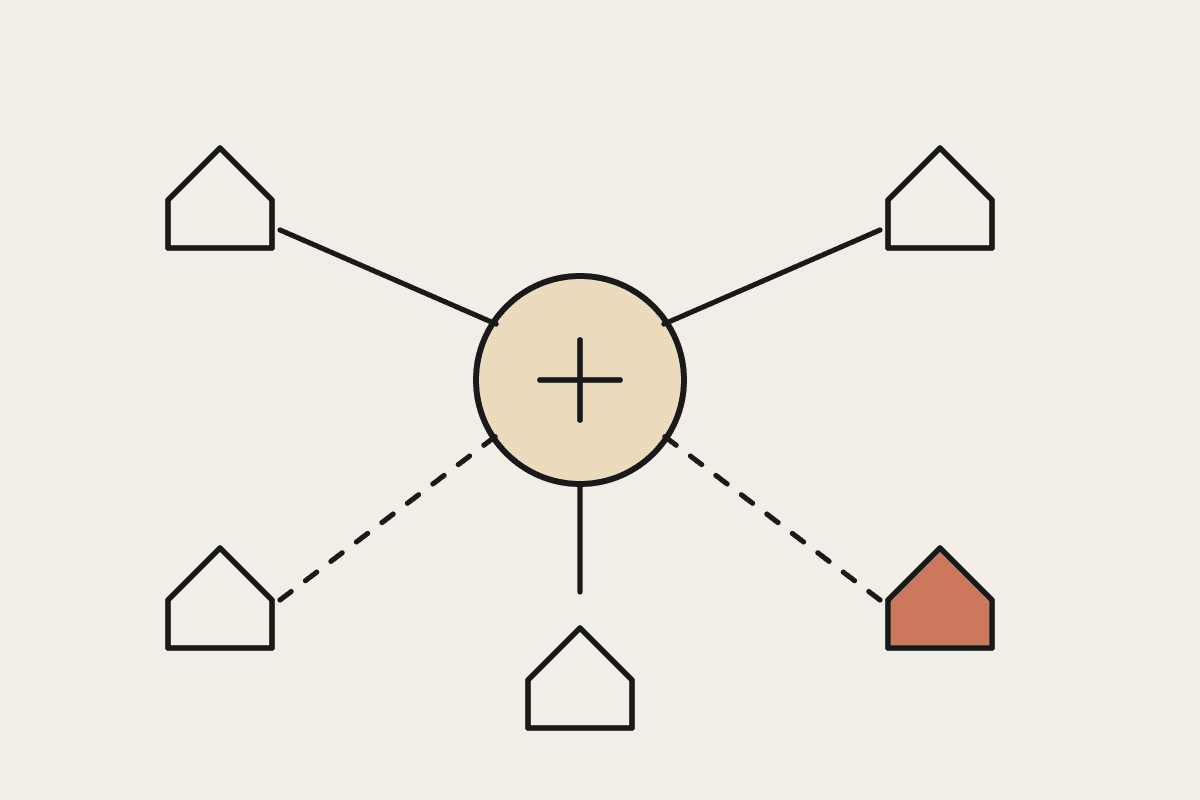
In most Australian franchise networks, head office does not own the customer data it wants to feed into an AI model. The franchisee does. Each location often runs its own point-of-sale system, holds its own customer list and trades under its own ABN. Any AI plan that starts with "pull everything into one place and put a model on top" is starting from a structure the network does not actually have.
We have had franchise groups ask whether a self-hosted open-weight model at head office, fed by data from every location, is the right architecture. The model choice is rarely the hard part. The harder question is who legally owns the data flowing into it, and whether the individual franchise agreements permit centralising it that way at all.
Can a franchise head office run AI on every location's customer data?
Only where the franchise agreement explicitly allows that data to be shared with head office for that purpose. In many Australian networks each franchisee is a separate business holding its own customer records, so pooling those records into a central AI system without a data-sharing clause risks breaching both the Privacy Act and the franchise agreement. Brand content and de-identified benchmarking are usually safe; pooled customer records usually are not.
This is why open source versus commercial is the second question for a franchise network, not the first. A self-hosted model at head office does not solve a data ownership problem. It relocates it to a server you run.
Where centralising genuinely helps
Brand-wide marketing copy and social content generation. No franchisee-specific customer data is involved at all, and consistency is exactly what head office is paid to deliver.
Aggregated, de-identified performance benchmarking across locations, comparing sales patterns by day, product or region without exposing any single customer's data to head office systems outside the original agreement.
Answering franchisee questions from the operations manual, so the documented standard is available at the moment someone needs it.
That last use is well suited to Claude, and the pattern is set out in our piece on Cowork for franchise networks. It works because the source material is head office's own operations manual, not anyone's customers.
Where it creates legal exposure
Any system that pools individual customer records across franchisees without an explicit data-sharing clause in the franchise agreement.
Using AI to make location-level staffing or pricing decisions based on pooled data that franchisees did not agree to share.
Training or fine-tuning a central open-weight model on customer records, which makes the data far harder to separate out if a franchisee leaves the network.
The third point is specific to self-hosting. Once one franchisee's customer data has shaped a fine-tuned model, deleting their records from a database does not remove that influence from the weights. For a network where franchisees join and exit every year, that is a practical problem as well as a legal one. The Privacy Act reforms landing through 2026 raise the stakes on getting this right.
| Data type | Usually owned by | Centralise for AI? |
|---|---|---|
| Brand guidelines, templates, operations manual | Franchisor | Yes |
| De-identified sales totals by location | Shared, per agreement | Yes, if the agreement covers reporting |
| Individual customer records and contact details | Franchisee | Only with an explicit data-sharing clause |
| Staff rosters and pay data | Franchisee as employer | No, keep at location level |
| Loyalty programme data run by head office | Franchisor | Yes, within the programme's privacy notice |
A worked example: a 22-location food franchise
Consider a Brisbane-based network of 22 outlets that wants AI help with three things: local social posts, a weekly performance report, and personalised win-back offers to lapsed customers.
The social posts are straightforward. Head office owns the brand, Claude drafts location-specific posts from approved templates, and franchisees approve before posting. The weekly report works if it uses de-identified sales totals that franchisees already report under the agreement, and it can remove a lot of Sunday-night admin for owners, as we described in head-office reporting for franchisees. The win-back offers are where it stops. They need individual customer records, and in this network those belong to each franchisee. The sensible design runs that workflow at location level, on each franchisee's own data, with a shared template from head office rather than a central customer pool.
What a sensible rollout costs
For a network of 15 to 30 locations, a properly scoped deployment covering brand-wide content generation and de-identified cross-location benchmarking, without touching individual customer records, typically costs $15,000 to $35,000 to build centrally. Each location then adds a modest per-site cost rather than triggering a full re-architecture.
Claude's enterprise agreement gives head office a documented data handling standard to point to when a franchisee asks what happens to their customer data. In this sector that matters more than the underlying model choice, because the question will be asked, often at a network meeting and often by the most sceptical franchisee in the room. As at September 2026, a self-hosted model means head office writes and defends that standard itself.
If you run or advise an Australian franchise network and want the data ownership question answered before an AI rollout rather than after a franchisee complains, book a session with us. Our services include a data-ownership review against your franchise agreement template.